
China controls more than 90 percent of the world’s rare earth processing capacity, using chemistry that dates back to 1917. The United States has the raw materials, most notably the Mountain Pass mine in California, but for decades it lacked the midstream infrastructure to turn that ore into usable, separated rare earth elements. That gap has become one of the most acute vulnerabilities in the US industrial base, touching everything from magnets in electric motors to components the defense industry depends on.
Today, we are pleased to announce our investment in Riven, a New York based company building an AI driven platform to design better separation chemistry and deploy modular processing capacity for critical minerals, starting with rare earths.
The round was led by Cerberus Ventures, the venture arm of Cerberus Capital Management, with meaningful commitments from New System Ventures, Scout Ventures, Alumni Ventures, and Lightscape Partners. Riven raised a total of $7.9 million and we are glad to be investing alongside a syndicate with this much depth in defense and industrial capital.
The Problem: A Century Old Process
Rare earth separation today still largely runs on PC-88A, a molecule from the ‘70s, dissolved in kerosene and mineral acid. It is a slow, environmentally hazardous process that requires hundreds of mixer settler tanks in sequence to reach commercial purity, because the molecule is not very selective. Feed a 50/50 mix of neodymium and praseodymium through a single stage and you might get 55/45 out the other end. Getting to 99.9 percent purity means repeating that marginal improvement over and over, at enormous capital and environmental cost.
The US has feedstock. What it has lacked is processing. MP Materials only began separating rare earths domestically within the last year, after decades of shipping ore to China for that step. The federal government has responded with real capital, including taking a direct equity stake in MP Materials alongside a ten year offtake agreement with a price floor, a strong signal of how seriously Washington now treats this as a national security problem, not just an industrial one.
The Solution: Designing Better Chemistry
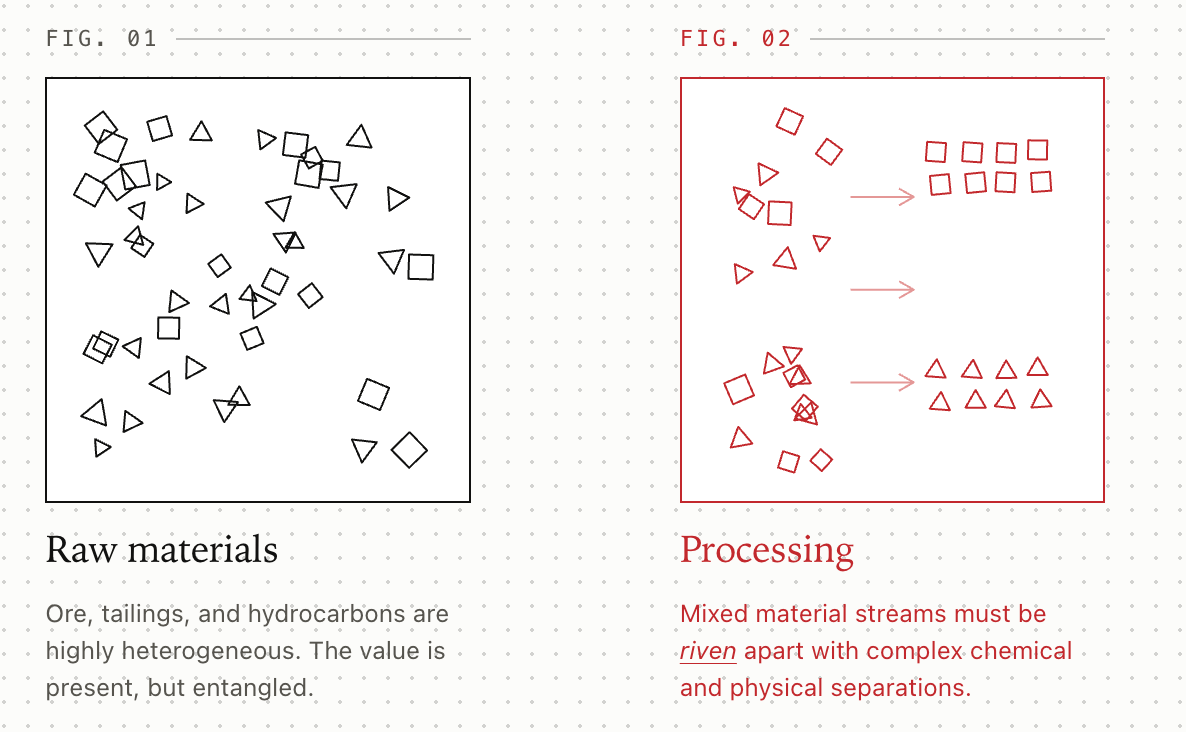
Riven seeks to play a key role in building a competitive, U.S. led alternative to China’s critical minerals supply chain. The company combines automated experimentation, computational modeling, and AI to develop and de-risk processing chemistry for domestic producers, compressing the cost and timeline of bringing new separation chemistry to market. The approach is grounded in real experimental data rather than simulation alone, which feeds models that identify and screen promising candidate molecules against the practical constraints of manufacturing at scale.
The company was also selected for a grant under the Department of Energy’s Genesis Mission, one of the most competitive funding opportunities the DOE has run, with fewer than 5 percent of applicants selected and only 19 companies chosen to lead a project. That kind of non dilutive validation matters in a sector where government demand and government capital are such a large part of the addressable market.
The Team
Riven was founded by Chip Breitenkamp, PhD and Orion Cohen, PhD, who met at Radical AI. Chip brings deep computational chemistry expertise and a track record scaling advanced materials companies. Orion’s PhD is in data driven materials science, from the lineage of Kristin Persson’s lab at Berkeley, the same lab that has staffed efforts at Periodic Labs, Radical AI, and materials programs inside Meta and Amazon. Orion is an NSF fellow, one of the most selective programs for early career scientists. The company was incubated by New System Ventures starting in the fall of 2025.
Why We Invested
We have been following Chip and Orion since Riven’s earliest days as an incubation at New System Ventures, and through every round since. We have watched the company move from a promising computational chemistry thesis to a self-driving lab generating real data every week, and from early customer discovery conversations to letters of intent with the largest rare earth players in the country.
Rare earth and critical mineral separation is some of the most strategic work happening at the intersection of AI and climate today. It sits at the center of the energy transition, since permanent magnets depend on it, and at the center of national security and reindustrialization, since the US has spent decades without the midstream capacity to process the resources it already has. Riven’s approach, using AI to design better chemistry rather than simply throwing more capital at 1917 era processes, is exactly the kind of leverage we look for.
We were also encouraged by the caliber of this round. Cerberus Ventures, the venture arm of Cerberus Capital Management, a $78B private equity fund led the funding round. Cerberus’s venture practice was founded by Chris Darby, who ran In-Q-Tel for seventeen years, and the firm’s depth of relationships across the Department of Energy, Department of Defense, and Department of Commerce is a meaningful signal for a company whose customers and champions increasingly sit inside the government.
We are glad to be supporting Chip, Orion, and the Riven team as they build.
If you are an investor, miner, or downstream partner interested in learning more, we are happy to make an introduction. Reach us at ajay@clai.vc and team@clai.vc.
This post was written by the CLAI Ventures team, a Silicon Valley based fund investing at the intersection of AI and climate.