
Concrete is the most widely used material on Earth after water, and cement production alone accounts for roughly 8 percent of global CO2 emissions. Much of the climate tech response has focused on reinventing the material itself. But the fastest and cheapest ton of carbon to avoid is the one never poured. Most buildings today use far more concrete than their loads require, because engineers simply do not have the time to explore better designs.
Today, we are pleased to announce our investment in Cimbra, a Cambridge, Massachusetts based company that uses AI driven generative optimization to design buildings that use 30 to 50 percent less concrete, starting with precast structural systems. We are glad to be joining a syndicate with deep roots in MIT and built environment ecosystems.
The Problem: Solving for the Wrong Variable
A large share of climate tech capital in the built environment has gone into new materials: low carbon cements, alternative binders, and novel concrete chemistries. These are important long term bets, but they miss why concrete became the dominant building material in the first place. Concrete is cheap, durable, and can be made almost anywhere in the world from locally sourced sand, gravel, water, and cement. Any replacement has to compete with that global availability, and with decades of building codes, supply chains, and contractor familiarity built around it.
Meanwhile, the way we design with concrete has barely changed. Structural engineers face long backlogs and tight bid timelines, so they default to standard, conservative sections such as flat slabs and hollowcore planks that are easy to specify but use far more material than the structure actually needs. Over-design is not a choice anyone makes deliberately. It is what happens when there is no time to explore alternatives.
We believe a much more immediate path to decarbonizing the built environment is to optimize design so that every building consumes much less material. That works with the concrete supply chain that already exists in every city on earth, rather than waiting for a new one to be built.
The Solution: Designing with Less
Cimbra spun out of MIT’s Digital Structures research group with a simple premise: the most effective way to cut a building’s embodied carbon is to design it to use less material from the start. Its platform explores up to roughly 500,000 structural design configurations in seconds, a search that would take an engineering team weeks to do by hand. It returns only options that are safe, code compliant, and fabrication ready. Users then filter those options by cost, carbon, labor, or other project objectives.
Crucially, Cimbra is built around how buildings actually get made. It integrates each precast manufacturer’s existing mold inventory and material libraries, so the optimized designs can be produced on today’s factory floors without new tooling. The result is preliminary engineering that takes seconds instead of days, and structural designs that use 30 to 50 percent less concrete, enabling users to bid more accurately and competitively
The approach has been validated at full scale. Working with manufacturing partner J.P. Carrara & Sons and funded by a Massachusetts Clean Energy Center InnovateMass grant, Cimbra designed and load tested a shape optimized precast slab. It came in 55 percent lighter, with correspondingly lower embodied carbon, than a conventional flat slab, and 33 percent lighter than a standard 8 inch hollowcore plank. The prototype was installed at Structures Congress 2026, the largest annual gathering of Structural Engineers in the US.
Where Carbon and Economics Point the Same Way
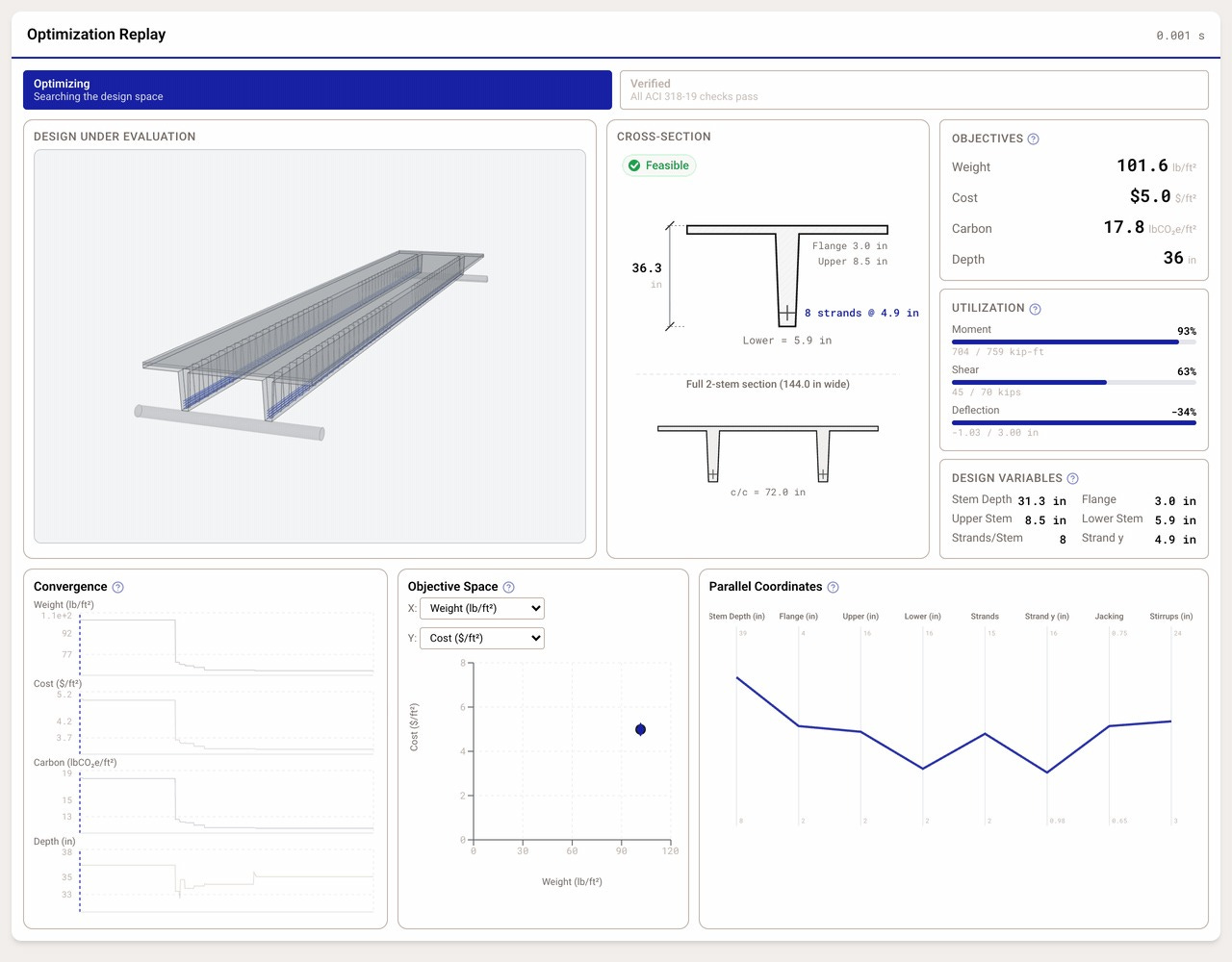
What makes Cimbra unusual in climate tech is that its decarbonization case requires no green premium. Less material used means dollars saved, and dollars saved means carbon saved. A builder does not have to value carbon at all to want what Cimbra delivers.
Cimbra has tied this directly to the moment where construction economics are decided: the bid. Precast manufacturers and general contractors use Cimbra to produce leaner, lower cost structural designs while they are pricing a project, and the software is already helping them win work. Partners and collaborators include Turner Construction, Prime Steel Erecting, Buro Happold, and Suffolk Technologies’ BOOST 7 program. Cimbra has already been instrumental in winning several prefab bids on residential and commercial projects.
Because Cimbra sits inside the bidding workflow, where every manufacturer and contractor competes on cost, we see the potential for it to become the industry standard for structural design and bidding, and to displace legacy engineering tools and spreadsheet based manual processes that were never built to search for the leanest design. Cimbra is a fundamentally new approach to estimation and engineering because it generates designs instead of just validating a design’s safety like existing engineering workflows. This also points to the potential to scale Cimbra’s tech into really any manufacturing-constrained space where engineering is a bottleneck.
The Team
Cimbra was founded by Sandy Curth, Kiley Feickert and Eduardo Gascón Alvarez, all PhDs out of MIT.
Sandy, the company’s CEO, comes from MIT’s Design and Computation group, with work focused on leveraging advanced manufacturing and widely available materials like concrete and earth to build low cost, low carbon housing and new construction.
Kiley, the company’s Chief Product Officer, is a licensed architect with hands-on experience across US and European construction projects including both the California and London Google offices. Her PhD research in the MIT Digital Structures group quantified how much embodied carbon design can cut at the building scale, identifying optimized concrete structures as one of the most promising opportunities.
Eduardo (CTO) is a licensed engineer and architect in Spain, whose PhD research focused on multi-physics optimization for structural design and building energy performance. They are joined by Keith Lee, the company’s first hire and Head of Structural Design and Computation, an expert in machine learning algorithms and manufacturability whose PhD at MIT produced the first differentiable structural optimization solver; he has taught numerous courses and workshops across three continents in computational design, optimization, and reuse. Together they combine structural engineering, computational design, and physics based simulation, and they founded Cimbra for the express purpose of reducing cost and carbon in new construction in rapidly urbanizing cities.
The team won the grand prize at the 2025 MIT Climate & Energy Prize, one of the most competitive university climate startup competitions in the world, and has been supported by MIT delta v and the Massachusetts Clean Energy Center.
Why We Invested
We first met Sandy, Kiley and Eduardo in June 2026 and have followed them closely since, through the full scale prototype with J.P. Carrara & Sons, and their first commercial bids. Over those months we watched Cimbra move from a research result to software that precast manufacturers use to price and win real projects. Precast is where Cimbra starts, and the team plans to extend it to estimation and engineering across cast-in-place concrete, timber, and steel. Applying Cimbra’s whole building optimization to cast-in-place concrete design, and other material systems around the world is where we see venture scale climate impact.
The built environment is one of the largest and hardest to abate sources of emissions, and most solutions ask the industry to pay more or change materials. Cimbra asks for neither. Its generative optimization across hundreds of thousands of designs turns directly into less concrete, lower cost, and lower carbon on every project. That alignment between economics and decarbonization is exactly the kind of leverage we look for.
As a fund led by a civil engineer, we also appreciate how rare it is to see a team pair this depth of structural and computational expertise with a clear path to commercial adoption.
We are glad to be supporting Sandy, Kiley, Eduardo and the Cimbra team as they build.
If you are a precast manufacturer, general contractor, structural engineer, developer, or investor interested in learning more, we are happy to make an introduction. Reach us at ajay@clai.vc and team@clai.vc.
This post was written by the CLAI Ventures team, a Silicon Valley based fund investing at the intersection of AI and climate.